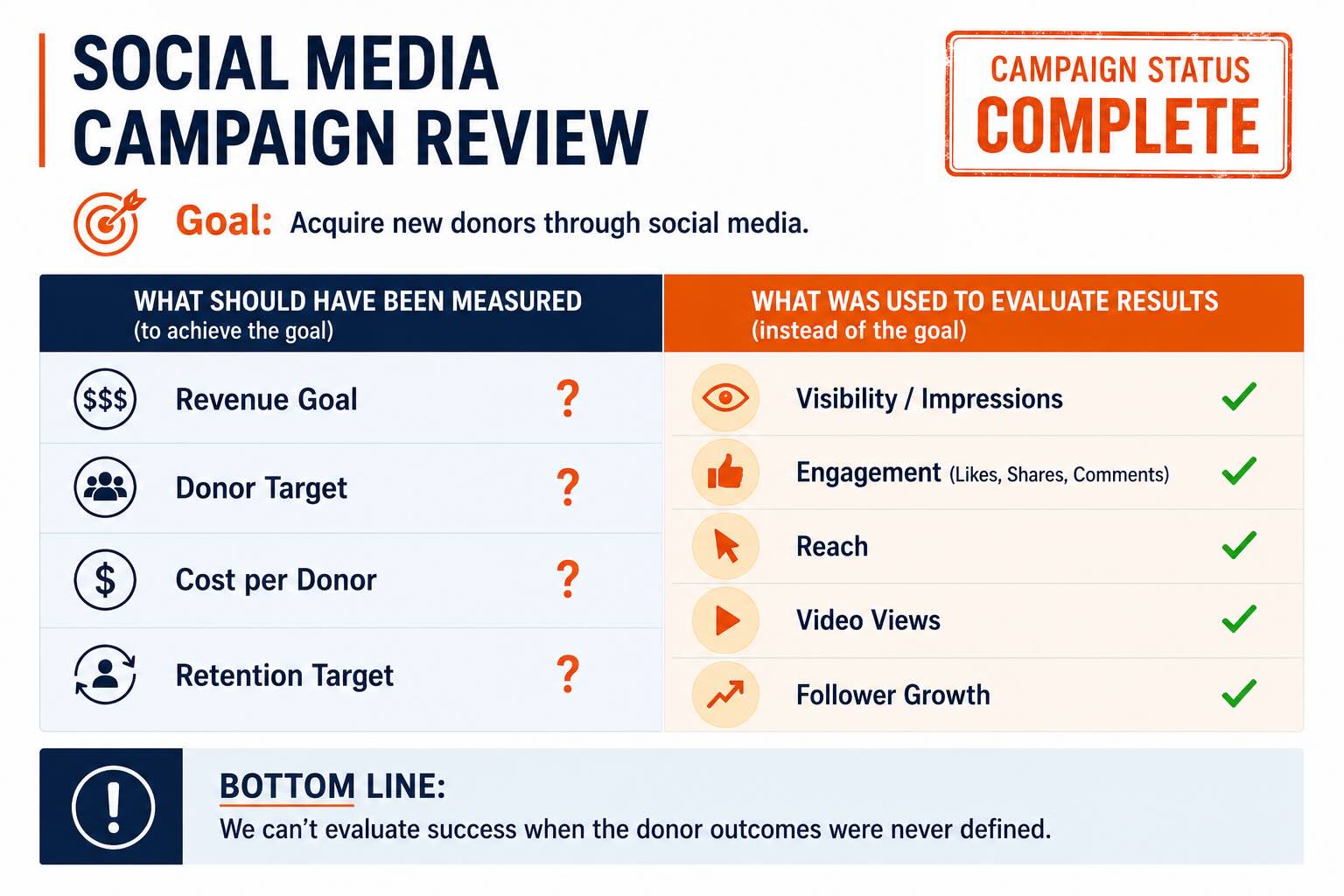
Working in communications and marketing strategy with non-profits, it quickly becomes apparent that visibility and donor acquisition are often conflated in social media strategy long before a campaign begins. Visibility is treated as the path to donors. That sounds logical, but it creates an accountability gap that must be examined honestly.
Visibility, engagement, and donor pipelines are often celebrated as successes, even though the revenue target that would define a successful donor acquisition campaign was never agreed at the outset.
Visibility is Not Donor Acquisition
Visibility and donor acquisition are not the same objective. They have different metrics, different timelines, and different definitions of success. Bundling them into a single campaign creates a convenient ambiguity. When donations don't materialize, visibility becomes the justification. The campaign worked, just not for fundraising.
The most common defense is the warming up argument. Social media plants the seed. The conversion happens elsewhere, at the gala, through the appeal, via a personal ask. This may well be true. But it is only a valid strategic argument if the organization can actually demonstrate it, with attribution data that tracks a donor's journey from social media touchpoint to gift. Without that evidence, warming up is not a finding. It is a story told in the absence of one. And a story, however plausible, is not a basis for a $30,000 decision.
The $30,000 question
Consider a non-profit that spends$30,000 on social media over twelve months. At year end, it has 200 newindividual donors at an average gift of $50. Total new revenue: $10,000. Threedollars spent to raise one, and most of those donors may not give again.
No cost per donor had been agreed before the campaign started. No retention target set. No cultivation plan for the 200 new donors. No revenue target linked to the campaign. Without those parameters, the pipeline remains a list.
The Questions Worth Asking First
Before a campaign budget is signed off, one question needs an honest answer: is this for visibility or acquiring donors who actually give? Not both. They are different objectives and conflating them is precisely how the accountability gap opens.
If the answer is visibility, define what success looks like, over what timeline, and how it will be measured independently of donations. If the answer is acquisition, define the revenue goal, how many donors at what average gift size will reach it, and what the acceptable cost of acquiring each one is.
Without those answers on the table before the campaign starts, visibility will always be available as the explanation for why donations did not come. And an explanation is not a strategy.
These questions are rarely asked because the people recommending the spend are rarely measured against the revenue outcome. Activity is easier to report on than return.